A cotton spandex blend combines cotton with elastane to create fabric that can offer a familiar cotton hand feel alongside improved stretch and recovery. However, choosing between 95% cotton / 5% spandex and 92% cotton / 8% spandex is not simply a matter of selecting the higher elastane percentage.
For apparel brands, designers, and textile buyers, the right blend ratio depends on the garment’s fit, fabric construction, weight, stretch direction, recovery, dimensional stability, and printing requirements.
This guide compares common cotton spandex ratios, explains how they influence fabric selection, and provides practical steps for evaluating materials before production.
Table of Contents: Cotton Spandex Blend
What Does Cotton Spandex Blend Mean?
A cotton spandex blend is a fabric containing cotton fibers and a proportion of spandex, also called elastane.
For example, a fabric labeled 95% cotton / 5% spandex contains those fibers in the stated proportions by mass, subject to applicable labeling and testing requirements.
Cotton contributes moisture absorption and cotton-like hand feel, while elastane provides elastic extension and recovery.
However, the finished fabric’s properties also depend on yarn selection, knitting or weaving, fabric finishing, and production conditions.
For a broader introduction to fabric types, GSM, applications, and digital printing, read our cotton spandex fabric guide.
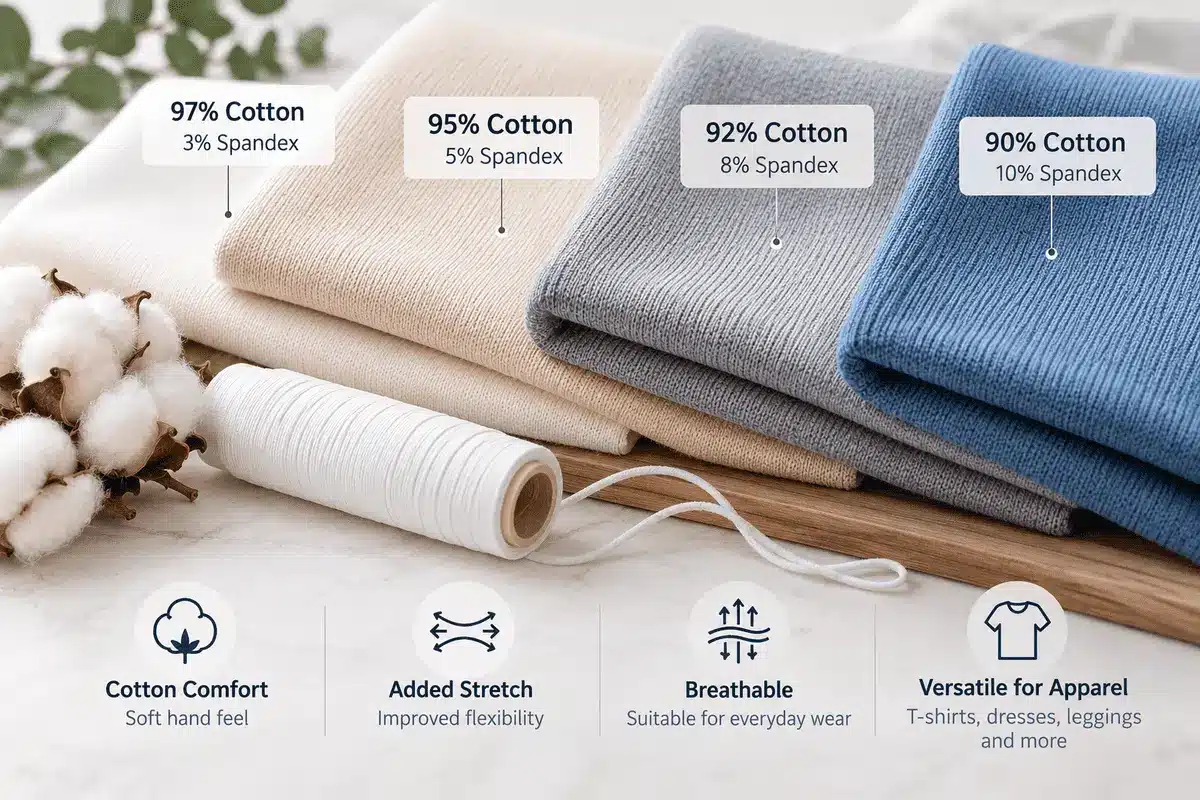
Common Cotton Spandex Blend Ratios
Cotton spandex blends are available in different compositions. The examples below are useful starting points for sourcing discussions, not fixed performance grades.
| Cotton / Spandex Ratio | Main Consideration | Potential Garment Applications |
|---|---|---|
| 97/3 | Cotton-rich fabric with a relatively small elastane component | Stretch shirts, casual tops |
| 95/5 | A widely used composition for cotton-rich stretch apparel | T-shirts, dresses, children’s clothing |
| 92/8 | A higher elastane proportion for designs requiring flexibility | Fitted tops, selected leggings |
| 90/10 | Higher elastane content that may suit close-fitting constructions | Fitted apparel, selected stretch garments |
95% Cotton 5% Spandex vs 92% Cotton 8% Spandex
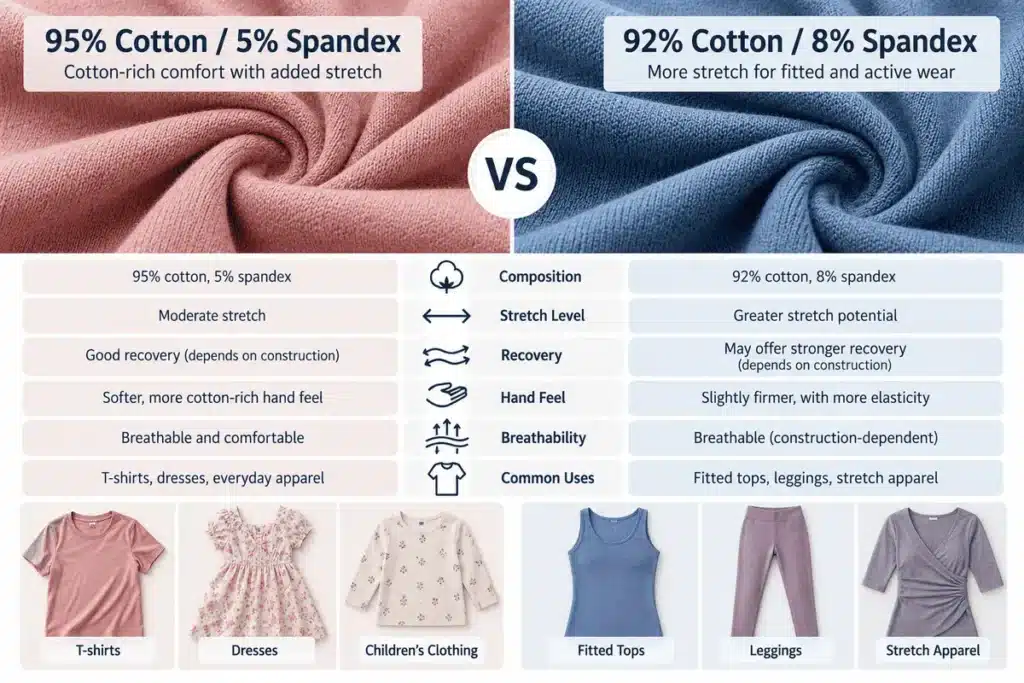
Two frequently considered compositions are 95/5 and 92/8.
Both contain predominantly cotton, but the different elastane proportions may influence fabric behavior when other construction factors are comparable.
95% Cotton / 5% Spandex
A 95/5 cotton spandex blend is often considered for cotton-rich garments that need added flexibility.
Potential applications include fitted T-shirts, casual dresses, everyday tops, and children’s apparel.
The fabric may offer a balance of cotton-rich hand feel and elastic recovery, depending on the knit or weave.
However, a 95/5 label alone does not establish whether the material is lightweight, opaque, soft, or suitable for leggings.
92% Cotton / 8% Spandex
A 92/8 cotton spandex blend contains a larger elastane proportion.
In otherwise comparable fabrics, this may support greater elastic extension or recovery, but the result is not guaranteed.
Potential applications include fitted tops, stretch dresses, and selected leggings.
For these garments, buyers should pay particular attention to opacity under stretch, recovery after repeated extension, and dimensional stability.
Side-by-Side Comparison
| Feature | 95/5 Cotton Spandex | 92/8 Cotton Spandex |
|---|---|---|
| Cotton content | 95% | 92% |
| Elastane content | 5% | 8% |
| Potential stretch | Depends on construction | May be greater under comparable conditions |
| Recovery | Requires testing | Requires testing |
| Fabric weight | Not determined by ratio | Not determined by ratio |
| Breathability | Construction-dependent | Construction-dependent |
| Print suitability | Must be confirmed | Must be confirmed |
| Best selection method | Sample and test | Sample and test |
Does More Spandex Mean More Stretch?
Not necessarily.
Spandex content is an important variable, but it is only one part of fabric engineering.
Fabric Construction
A rib knit can stretch differently from a single jersey even when both contain 5% elastane.
Interlock and woven stretch fabrics also behave differently because of their construction.
Yarn and Elastane Arrangement
Yarn count, elastane yarn characteristics, and how the elastane is incorporated into the fabric can affect extension and recovery.
Two fabrics with the same composition may therefore feel and perform differently.
Fabric Finishing
Heat setting, washing, relaxation, and other finishing processes may influence final dimensions and stretch behavior.
Fabric Weight and Density
GSM and fabric density can influence drape, opacity, and how the material feels during stretching.
A heavier fabric is not necessarily more elastic, and a lighter fabric is not necessarily less durable.
Stretch Percentage vs Stretch Recovery
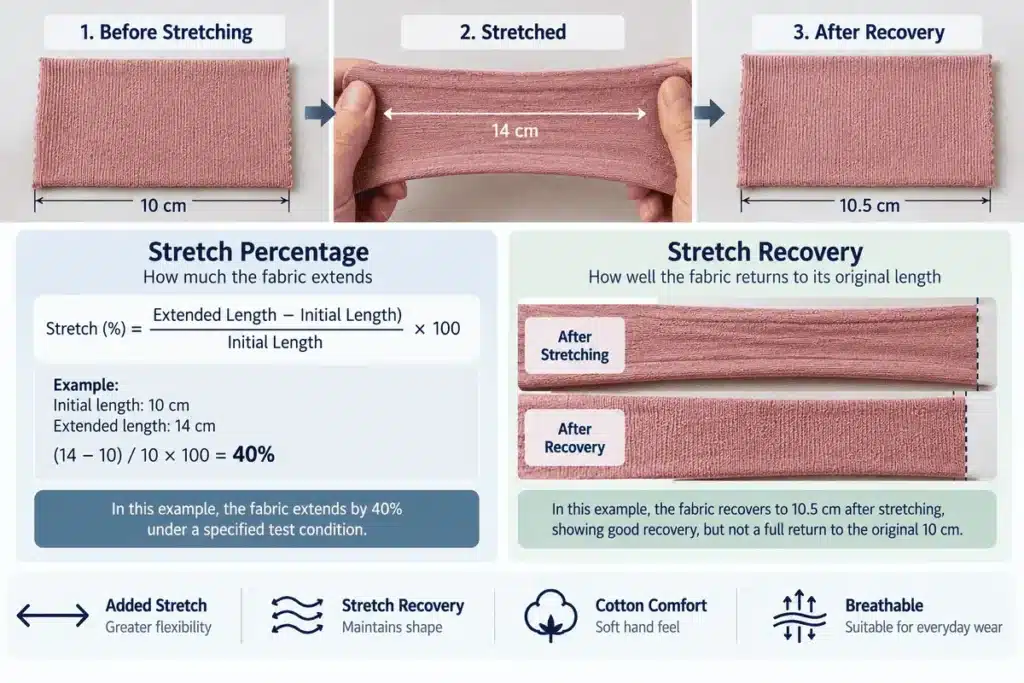
Stretch and recovery are related but different measurements.
Stretch percentage describes how much a fabric extends under a defined test condition.
Stretch recovery describes how well it returns toward its original dimensions after the applied force is removed.
Example: Calculating Stretch Percentage
Suppose a test specimen has an initial gauge length of 10 cm and extends to 14 cm under a specified load.
Stretch percentage can be expressed as:
Stretch (%) = [(Extended Length − Initial Length) / Initial Length] × 100
In this example:
[(14 − 10) / 10] × 100 = 40%
This is a calculation example, not a measured value for a particular cotton spandex fabric.
Recovery requires a separate measurement after relaxation, following a defined testing procedure.
Why Recovery Matters
Poor recovery can contribute to bagging or unwanted dimensional changes in areas such as knees, elbows, and waistbands.
For fitted garments, buyers should assess recovery as well as initial stretch.
Testing Stretch Fabric
A basic manual stretch check may help compare fabric feel, but it cannot replace standardized testing.
For commercial sourcing, request test reports that identify the test method, direction, applied load, conditioning, and measured results.
Organizations such as ASTM International and AATCC publish textile testing standards and technical resources.
How Blend Ratios Affect Shrinkage
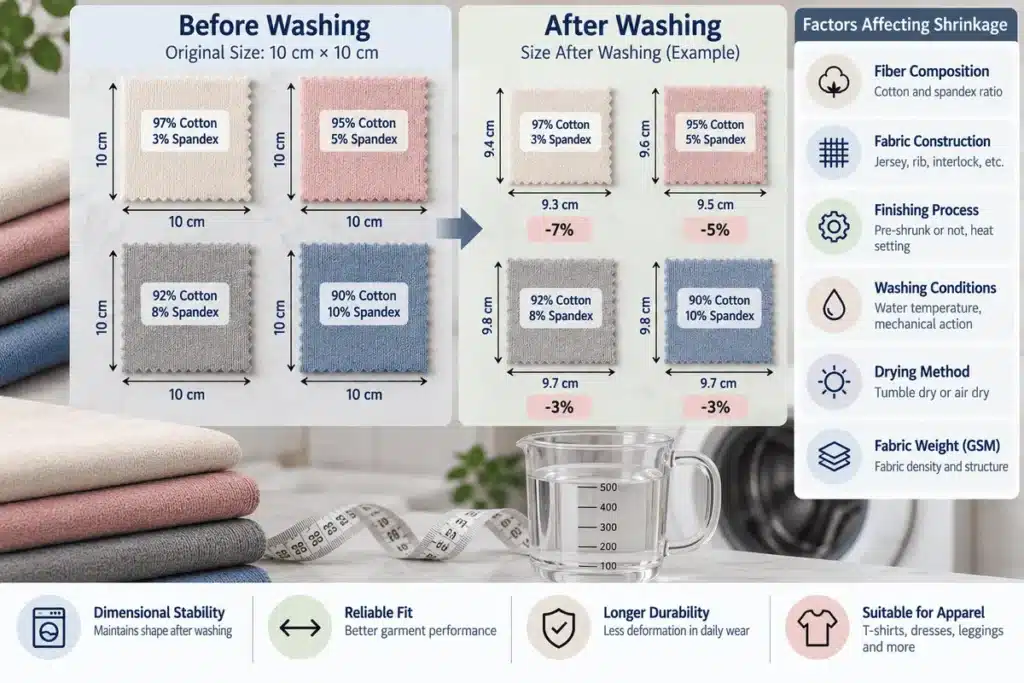
Cotton spandex fabric can shrink or change dimensions during laundering and finishing.
The percentage of elastane does not, by itself, determine shrinkage.
Important factors include:
Cotton fiber and yarn characteristics
Knit or weave construction
Fabric relaxation and finishing
Washing temperature and mechanical action
Drying conditions
Prior processing and dimensional stabilization
For example, two 95/5 fabrics from different suppliers may show different dimensional changes after washing.
When developing garments, request dimensional stability results under care conditions appropriate for the finished product.
For additional guidance, review our cotton spandex fabric guide.
Choosing a Cotton Spandex Ratio for Different Garments
Instead of choosing fabric solely by composition, start with the performance needs of the garment.
T-Shirts and Everyday Tops
For casual tops, consider hand feel, drape, fabric weight, stretch comfort, and dimensional stability.
A 95/5 jersey may be a useful candidate, but its suitability depends on construction and garment design.
Leggings and Fitted Pants
For leggings, prioritize opacity under stretch, recovery, abrasion resistance, seam performance, and fit.
A 92/8 or 90/10 blend may be considered, but neither ratio automatically guarantees adequate coverage or performance.
Children's Clothing
For children’s everyday garments, evaluate comfort, stretch, durability, care performance, and relevant product safety requirements.
Fiber composition alone does not establish compliance with applicable safety standards.
Dresses and Fitted Fashion
For fitted dresses, compare stretch direction, recovery, drape, opacity, and surface appearance.
A rib knit may behave differently from a jersey even when both use the same cotton spandex ratio.
Custom Printed Apparel
When producing printed garments, consider how the fabric behaves both during printing and when stretched in use.
This is particularly important for stripes, geometric patterns, logos, and designs with precise repeat alignment.
Does Cotton Spandex Ratio Affect Digital Printing?
It can, but the relationship is not determined by fiber percentages alone.
Printing suitability depends on the actual fabric, ink or dye system, pretreatment, processing temperature, fabric tension, and finishing requirements.
Print Compatibility
Cotton-rich fabrics may be suitable for compatible reactive or pigment printing processes, subject to testing and supplier capabilities.
Elastane-containing fabrics require attention to processing conditions that could affect stretch and dimensional stability.
Pattern Distortion
A printed design may change appearance when the fabric is stretched.
Before production, evaluate the artwork on both relaxed and extended fabric, especially for precise geometric patterns.
Color and Wash Performance
Ask for relevant wash colorfastness, rubbing colorfastness, and dimensional stability results.
A sample print can help verify appearance before a larger order.
Learn more in our fabric printing methods guide and artwork preparation guide.
Cotton Spandex Blend Buying Checklist
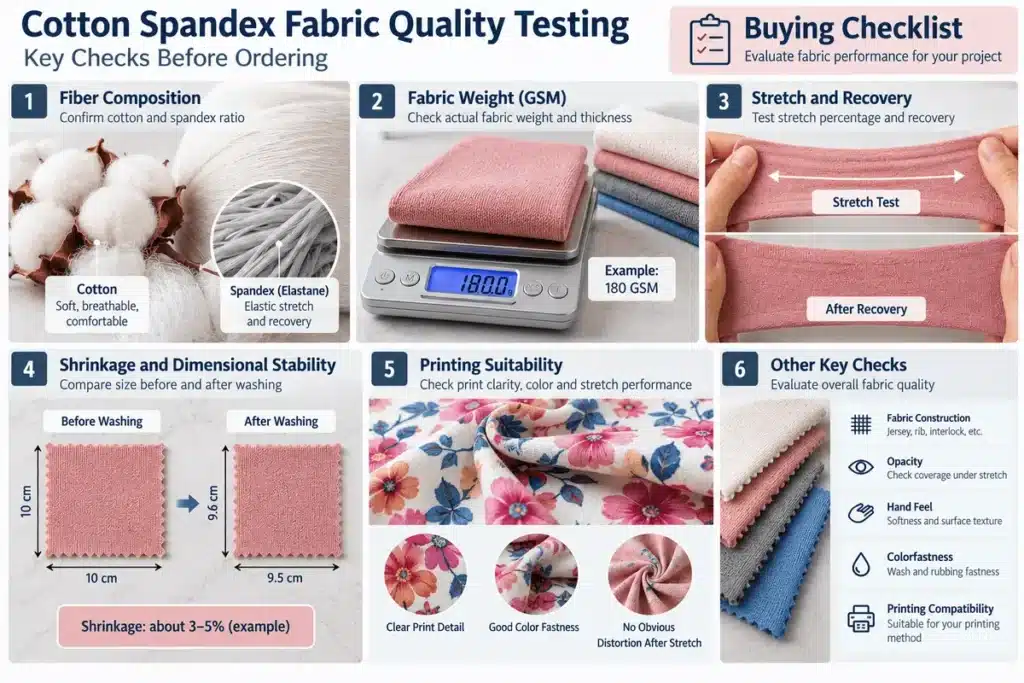
For clothing brands and textile buyers, the following information is useful when comparing suppliers.
| Specification | What to Confirm |
|---|---|
| Fiber composition | Exact cotton and elastane percentages |
| Construction | Jersey, rib, interlock, or woven |
| GSM | Actual fabric weight |
| Width | Usable width after finishing |
| Stretch | Measured extension by direction |
| Recovery | Results under a stated test method |
| Shrinkage | Dimensional change after laundering |
| Opacity | Appearance under intended extension |
| Colorfastness | Relevant wash and rubbing results |
| Printing | Process compatibility and sample approval |
Questions to Ask Before Ordering
Ask your supplier:
Is the fiber composition supported by a specification or test report?
What are the measured stretch and recovery results?
Has the fabric been tested for shrinkage?
Is the material suitable for the intended garment and printing process?
Can a swatch or printed sample be reviewed before production?
These questions are more reliable than selecting a fabric based only on a 95/5 or 92/8 label.
Custom Cotton Spandex Printing for Clothing Brands
At JCWTextile, we offer custom fabric printing services for designers, small businesses, and wholesale buyers, including projects that do not require a minimum order quantity.
If your project involves cotton spandex, confirm the availability of the desired construction and its compatibility with the intended printing process.
Explore Our Fabrics, Design Your Fabric, or Get a Quote to discuss your requirements.
Conclusion
Choosing the right cotton spandex blend requires more than comparing cotton and elastane percentages.
A 95/5 fabric may suit one garment, while a 92/8 fabric may be more appropriate for another. Construction, stretch, recovery, shrinkage, opacity, and printing compatibility are all essential considerations.
For clothing brands and textile buyers, the most reliable approach is to compare technical specifications and approve samples before production.
Planning a custom printed stretch-fabric collection? Explore our fabric selection or request a quote to discuss available materials and printing options.
📚 Frequently Asked Questions (FAQs)
1. What is a cotton spandex blend?
A cotton spandex blend is a fabric containing cotton and elastane fibers. Cotton contributes its characteristic hand feel and moisture absorption, while elastane adds elastic extension and recovery.
2. Is 95% cotton and 5% spandex stretchy?
It can be. Actual stretch depends on the fabric construction, yarn arrangement, and finishing, not just the 5% elastane content.
3. Is 92% cotton and 8% spandex better than 95/5?
Not necessarily. A 92/8 blend contains more elastane, but the better choice depends on the garment’s fit, construction, stretch requirements, and tested performance.
4. What does 95/5 cotton spandex mean?
It means the fabric contains 95% cotton and 5% spandex by fiber mass, subject to applicable labeling requirements.
5. Does more spandex prevent shrinking?
No. Dimensional stability depends on construction, processing, and laundering conditions as well as fiber composition.
6. Which cotton spandex ratio is best for leggings?
There is no universally best ratio. Leggings require adequate opacity, recovery, fit, and durability. These properties should be tested in the selected fabric.
7. What is the difference between stretch and recovery?
Stretch measures fabric extension under specified conditions. Recovery measures how effectively the material returns toward its original dimensions after stretching.
8. Can 95/5 cotton spandex be digitally printed?
Some 95/5 cotton spandex fabrics can be digitally printed using compatible processes. The selected material and printing method should be tested before production.