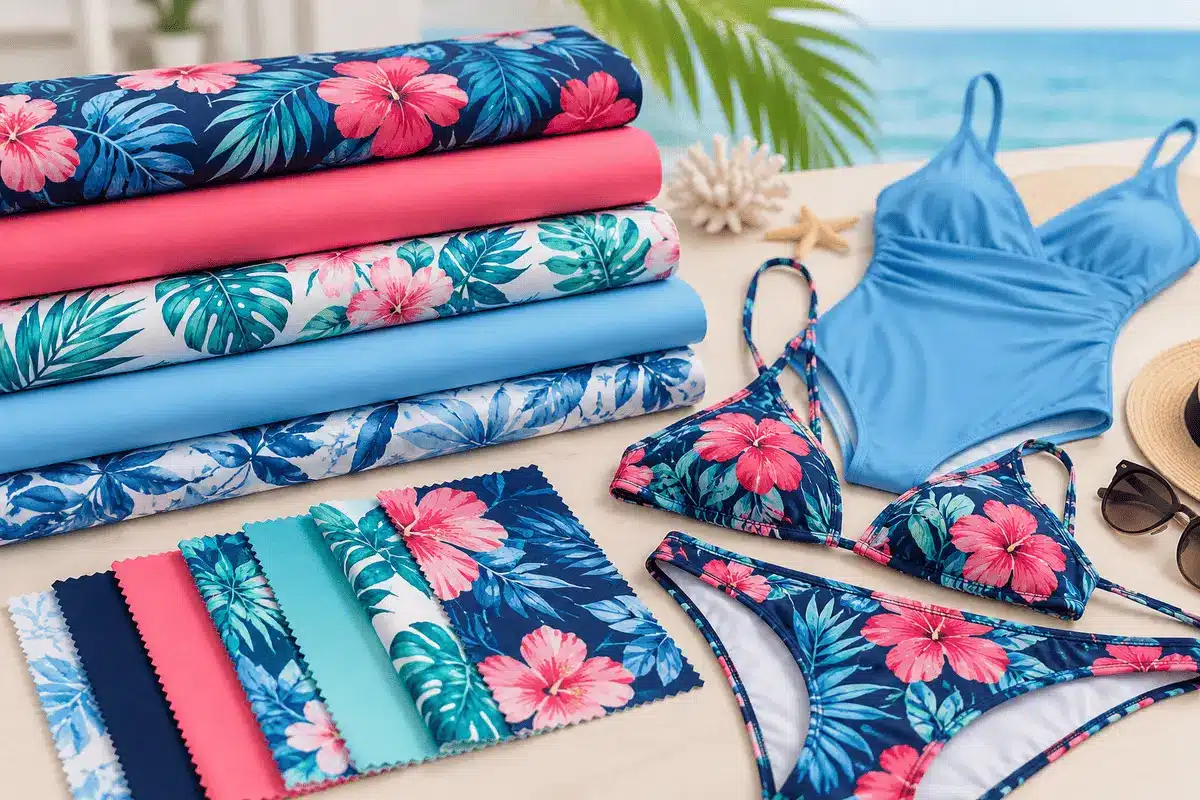
Choosing the right swimwear fabric by the yard is one of the most important decisions when developing bikinis, one-piece swimsuits, rash guards, or a new swimwear collection. The fabric must offer more than an attractive color or pattern. It should provide suitable stretch, recovery, coverage, comfort, and performance during repeated exposure to water.
For independent designers, swimwear brands, and small clothing businesses, buying swimwear fabric by the yard makes it possible to test different materials before committing to larger production quantities.
In this guide, we explain the main types of swimwear fabric, how to compare polyester and nylon blends, what GSM means for swimsuit construction, and how to choose materials for custom digital printing.
Table of Contents: Swimwear Fabric by the Yard
What Is Swimwear Fabric by the Yard?
Swimwear fabric is a textile selected for garments intended to be worn in or around water. Many fitted swimsuits use knitted fabrics containing elastane, also known as spandex, to provide stretch and help garments retain their shape.
The term by the yard describes a purchasing unit. One linear yard equals 36 inches (91.44 cm) of fabric length. The total amount of material received also depends on the fabric’s usable width.
For example, a fabric sold in one-yard lengths at a width of 150 cm provides a different cutting area from a fabric with a width of 140 cm.
When buying swimsuit fabric by the yard, always confirm:
Fiber composition and elastane percentage
Fabric weight in GSM
Usable width
Stretch direction and recovery
Opacity when wet and stretched
Printing compatibility
Colorfastness and dimensional stability
Minimum order quantity and sample availability
A fabric that looks attractive on a roll may behave differently when stretched over the body or exposed to water.
Types of Swimwear Fabric
Different swimwear designs require different materials. Polyester-spandex knits, nylon-spandex knits, and woven boardshort fabrics are common options, but they are not interchangeable.
1. Polyester Spandex Swimwear Fabric
Polyester-spandex blends combine polyester fibers with elastane to create flexible fabrics suitable for fitted swimwear.
Potential advantages include good dimensional stability, compatibility with certain polyester printing processes, and the ability to produce detailed custom patterns.
The actual performance depends on yarn quality, knit construction, dyeing, finishing, and testing.
JCWTextile offers PYK200 Swim Lycra Fabric, currently listed with the following specifications:
| Specification | PYK200 |
|---|---|
| Composition | 88% Polyester / 12% Spandex |
| Fabric weight | 200–220 GSM |
| Width | 150 cm |
| Construction | Knitted |
| Printing | Digital printing |
| Listed minimum order | 1 meter |
These are the currently published product specifications. Buyers should confirm the latest details and any required performance documentation before production.
2. Nylon Spandex Swimwear Fabric
Nylon-spandex fabric is another widely used option for bikinis, one-piece swimsuits, and fitted swim garments.
Depending on construction and finishing, nylon blends can offer a smooth surface, comfortable hand feel, and strong stretch characteristics.
However, nylon should not automatically be considered softer, more durable, or more chlorine-resistant than every polyester alternative. These properties depend on the specific fabric.
JCWTextile also lists an SPF50 Swim Fabric product with a published composition of 80% Nylon / 20% Spandex and a weight of 220 GSM.
For sun-protective swimwear, request a verified textile UPF test report rather than relying solely on a product name.
3. Swim Lycra Fabric
Swim Lycra is a commonly used commercial term for stretchy swimsuit material.
According to The LYCRA Company, LYCRA® is a branded elastane fiber, while spandex and elastane are generic terms for the same category of elastic fibers. Not every fabric containing spandex uses authentic LYCRA® fiber.
When comparing swim lycra fabric by the yard, focus on the actual fiber composition, knit structure, stretch recovery, weight, and test results instead of the product name alone.
4. Boardshort Fabric
Boardshort fabrics serve a different purpose from fitted swimsuit knits.
Many boardshorts use lightweight woven polyester or nylon fabrics. Some contain elastane for additional flexibility, while others are designed with little or no mechanical stretch.
JCWTextile offers both PS9307 Boardshort Fabric and PS1001 Non-Stretch Boardshort Fabric.
These options may be more appropriate for loose-fitting swim shorts than a conventional stretch swimsuit knit.
Polyester vs Nylon Swimwear Fabric
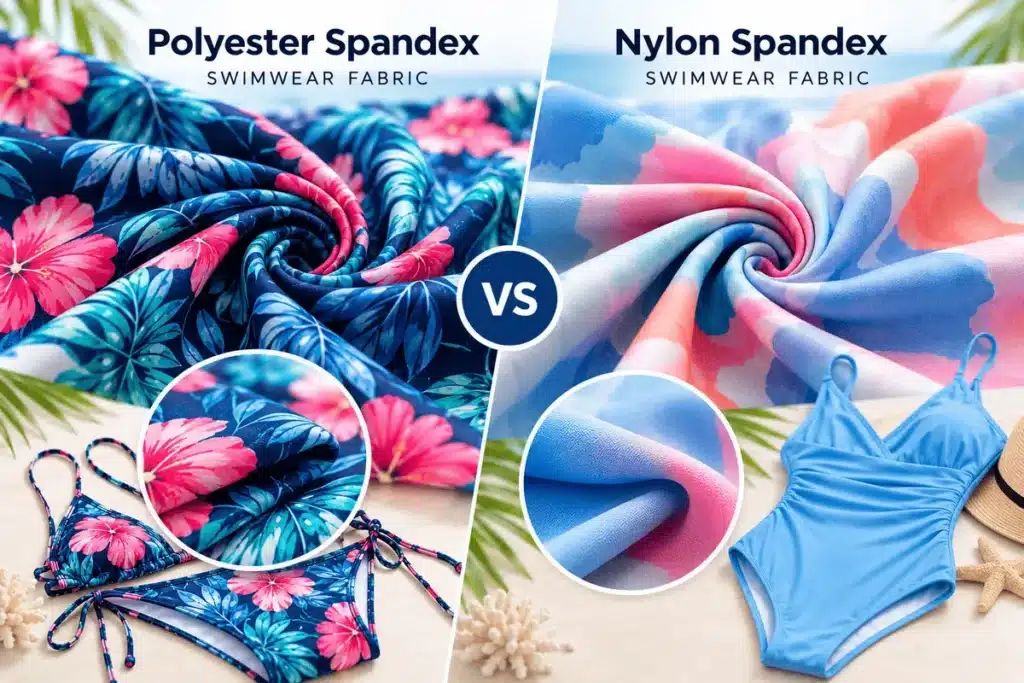
Polyester and nylon are both synthetic fibers commonly used in swimwear, but their performance should be evaluated at the fabric level.
| Feature | Polyester Spandex | Nylon Spandex |
|---|---|---|
| Typical construction | Stretch knit | Stretch knit |
| Common applications | Swimsuits, rash guards, active swimwear | Bikinis, one-piece swimsuits, fitted swimwear |
| Hand feel | Depends on knit and finish | Depends on knit and finish |
| Stretch and recovery | Influenced by elastane and construction | Influenced by elastane and construction |
| Custom printing | Polyester-compatible printing processes | Requires nylon-compatible printing processes |
| Chlorine resistance | Must be verified for the specific fabric | Must be verified for the specific fabric |
| UV protection | Requires fabric-specific testing | Requires fabric-specific testing |
2-Way vs 4-Way Stretch Swimwear Fabric
Stretch is essential for fitted swimwear because the garment must accommodate movement while maintaining a secure fit.
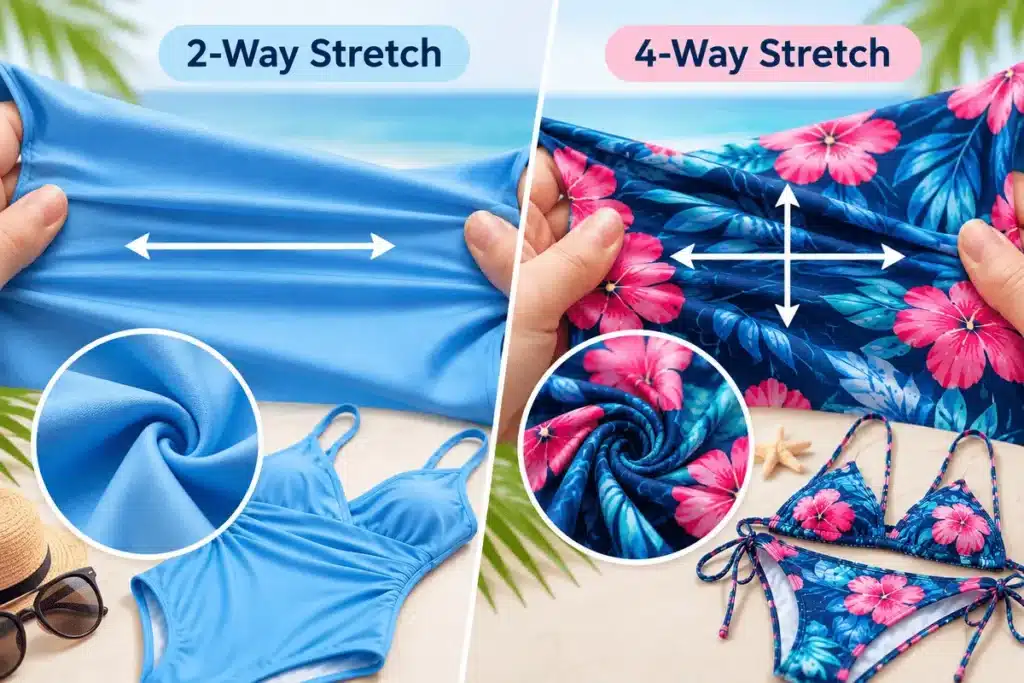
What Is 2-Way Stretch?
In retail terminology, 2-way stretch generally refers to fabric that stretches primarily across one axis, often across the width.
Terminology varies among suppliers, so buyers should request actual stretch measurements in the lengthwise and crosswise directions.
What Is 4-Way Stretch?
Four-way stretch describes fabric that stretches in both the lengthwise and crosswise directions.
This construction is commonly selected for fitted swimwear, performance garments, and clothing requiring freedom of movement.
However, 4-way stretch does not tell you how far the fabric stretches or how well it returns to its original dimensions.
Why Stretch Recovery Matters
Stretch recovery is the fabric’s ability to return toward its original dimensions after being extended.
Poor recovery can contribute to bagging, loose fit, and distortion after repeated wear.
When evaluating swimwear fabric, request or conduct:
Lengthwise and crosswise stretch measurements
Stretch recovery testing
Repeated-extension testing
Wet-fit assessment
Dimensional stability testing after laundering
The required stretch percentage depends on the garment pattern and intended fit.
Choosing the Right Swimwear Fabric GSM

GSM means grams per square meter. It measures fabric mass per unit area, not thickness directly.
GSM is useful when comparing swimwear fabrics, but it does not independently determine opacity, support, or quality.The following ranges are broad starting points rather than universal standards.| Approximate GSM | General characteristics | Potential applications |
|---|---|---|
| 150–180 GSM | Relatively lightweight | Lightweight swim tops or lining candidates, subject to testing |
| 180–200 GSM | Light-to-medium weight | Some fashion swimwear and stretch swim tops |
| 200–220 GSM | Medium weight | Bikinis, one-piece swimsuits, rash guards |
| 220–250 GSM | Medium-to-heavy weight | Supportive swimwear and structured designs |
| Above 250 GSM | Heavier constructions | Specialized or more structured garments |
Chlorine Resistance, Saltwater and UV Protection
Performance claims are particularly important when purchasing swimwear fabric by the yard for commercial production.
Chlorine Resistance
Pool water can affect elastane, dyes, and fabric finishes over time.
Chlorine resistance depends on the complete textile system, including the elastane type, fabric construction, dyes, finishes, and exposure conditions.
If a supplier describes a fabric as chlorine-resistant, request relevant test information and confirm whether the results apply to the exact material being purchased.
For printed swimwear fabrics, colorfastness to chlorinated pool water can be evaluated using AATCC TM162. This test method helps assess color change under specified chlorinated-water conditions, but it does not independently establish the fabric’s long-term elasticity or overall durability.
Saltwater Exposure
Swimwear intended for beach use should be evaluated for colorfastness and performance after exposure to seawater.
Saltwater resistance should not be inferred solely from polyester or nylon content.
UV Protection and UPF
UPF stands for Ultraviolet Protection Factor and is the terminology commonly used to describe the ultraviolet protection of textiles.
A claim such as UPF 50+ should be supported by testing under a recognized method applicable to the target market.
Fabric stretch, moisture, color, construction, and wear can influence UV protection.
For children’s swimwear or protective rash guards, verify the required performance and regulatory obligations before making product claims.
Custom Printed Swimwear Fabric
Custom printing allows swimwear brands to create original floral patterns, tropical designs, geometric prints, logos, and coordinated seasonal collections.
When ordering custom printed swimwear fabric, the fabric and printing method must be selected together.
Printing on Polyester Spandex
Polyester-based fabrics are commonly printed using disperse dyes. Sublimation transfer is one possible method for suitable polyester substrates.
Process compatibility depends on the fabric composition, elastane content, temperature tolerance, and finishing requirements.
Excessive heat can affect stretch fabrics, so the process should be validated before production.
Printing on Nylon Spandex
Nylon blends require compatible colorants and carefully controlled processing.
They should not automatically be treated as interchangeable with polyester in sublimation printing.
Artwork Preparation
For successful printed swimwear collections:
Prepare high-resolution artwork at the intended print dimensions.
Check seamless repeats and pattern scale.
Identify important brand colors.
Request a printed sample before bulk production.
Evaluate colors after stretching and washing.
Confirm acceptable color variation between production batches.
For more information, see JCWTextile’s custom fabric printing services.
Choosing Swimwear Fabric for Different Garments
The best material depends on the finished garment rather than the category name alone.
| Garment | Important fabric characteristics |
|---|---|
| Bikini | Stretch recovery, opacity, comfort, lining compatibility |
| One-piece swimsuit | Multi-directional stretch, recovery, dimensional stability |
| Rash guard | Comfortable stretch, coverage, verified UV performance if claimed |
| Swim trunks | Lightweight construction, comfort, appropriate stretch |
| Boardshorts | Woven durability, drying behavior, optional mechanical stretch |
| Children’s swimwear | Comfort, verified chemical compliance and applicable safety requirements |
| Competitive swimwear | Fit, drag-related construction, recovery and sport-specific requirements |
How to Buy Swimwear Fabric by the Yard
Buying small quantities is useful during the early stages of swimwear development.
Step 1: Define the Garment
Identify whether the fabric will be used for a bikini, one-piece swimsuit, rash guard, swim shorts, or lining.
Different designs place different demands on stretch, opacity, and support.
Step 2: Choose the Fiber Blend
Compare polyester-spandex and nylon-spandex options according to the intended use and printing requirements.
Do not assume that two fabrics with the same elastane percentage will have identical performance.
Step 3: Confirm GSM and Width
Request the fabric’s GSM and usable width, then calculate the required yardage using your garment patterns and expected cutting waste.
Step 4: Order a Sample
Evaluate the sample for:
Hand feel and drape
Dry and wet opacity
Stretch and recovery
Print sharpness and color
Washing performance
Compatibility with lining and sewing methods
Step 5: Test Before Bulk Production
For commercial swimwear, agree on the relevant performance requirements with the supplier.
These may include dimensional stability, colorfastness, stretch recovery, chlorine exposure, seawater exposure, and UV protection where applicable.
Step 6: Confirm Pricing and Lead Time
Pricing may vary by material, design, order size, printing process, and finishing requirements.
JCWTextile publishes fabric printing price guidance, but final commercial orders should be confirmed through a current quotation.
Custom Swimwear Fabric for Small Brands and Wholesale Buyers
Developing a swimwear collection often involves multiple rounds of sampling.
Small brands may need only a few meters for prototypes, while established manufacturers may require consistent repeat orders.
JCWTextile supports custom fabric printing for designers, businesses, and brands, with small-order and wholesale options.
The PYK200 product page currently lists a minimum order of one meter, making it a possible starting point for sample development.
For larger projects, discuss production consistency, color matching, testing requirements, delivery schedules, and repeat-order availability before confirming the order.
Explore PYK200 Swim Lycra Fabric or contact JCWTextile to discuss custom printed swimwear fabric for your collection.
Final Thoughts
Choosing the right swimwear fabric by the yard requires more than selecting a color or fiber blend. Fabric construction, stretch recovery, GSM, opacity, printing compatibility, and verified performance all influence the finished garment.
For swimwear brands and independent designers, testing a small sample before bulk production is one of the most effective ways to reduce material selection risks.
JCWTextile offers custom printed swimwear fabric options for sample development and larger orders.
Explore our PYK200 Swim Lycra Fabric and start planning your next custom swimwear collection.
📚 Frequently Asked Questions About Swimwear Fabric by the Yard
1. What is the best fabric for making swimsuits?
Polyester-spandex and nylon-spandex knits are common choices for fitted swimsuits. The best option depends on stretch recovery, opacity, comfort, durability, and the intended garment design.
2. Can I buy swimwear fabric by the yard?
Yes. Some suppliers sell swimwear fabric in small quantities, including by the yard or meter. Check the minimum order, usable width, and whether custom printing is available.
3. Is polyester or nylon better for swimwear?
Neither is universally better. Both can be suitable for swimwear, depending on construction, elastane content, finishing, printing requirements, and tested performance.
4. What GSM is best for swimwear fabric?
Many fitted swimwear fabrics fall around 180–250 GSM, but this is only a general guide. The ideal weight depends on opacity, support, stretch, lining, and garment design.
5. Does swimwear fabric need 4-way stretch?
Four-way stretch is commonly preferred for fitted swimsuits because it allows movement in both directions. Some swim shorts and boardshorts use woven fabrics with less stretch.
6. Can swimwear fabric be custom printed?
Yes. Many polyester and nylon swimwear fabrics can be custom printed using suitable processes. Printing compatibility and finished performance should be confirmed through sampling.
7. Is all polyester spandex fabric chlorine-resistant?
No. Chlorine resistance depends on the specific fabric, elastane, dyes, finishes, and testing. It should not be assumed from fiber composition alone.
8. What is the difference between swimsuit fabric and boardshort fabric?
Fitted swimsuit fabric is commonly a stretch knit containing elastane. Boardshort fabric is often a lightweight woven material that may have limited stretch or contain elastane for flexibility.
9. Does swimwear fabric provide UV protection?
Some fabrics offer tested ultraviolet protection, but the protection level varies. Look for verified UPF results if UV protection is an important product requirement.
10. Should I order a sample before buying swimwear fabric in bulk?
Yes. Sampling allows you to evaluate stretch, recovery, opacity, color, printing quality, and garment fit before committing to a larger order.