Cotton jersey material is one of the most widely used knitted textiles for T-shirts, casual dresses, children’s clothing, loungewear, and everyday fashion. Its soft texture, flexible construction, and comfortable feel make it a practical choice for both home sewing and commercial garment production.
However, not all cotton jersey fabrics perform the same way. Fabric weight, knit construction, fiber composition, stretch recovery, shrinkage, and finishing can significantly affect the finished garment.
A lightweight cotton jersey may be suitable for a breathable summer T-shirt, while a heavier jersey may offer more coverage and structure for dresses or relaxed clothing.
In this guide, we explain cotton jersey GSM, stretch properties, fabric types, apparel applications, and digital printing considerations to help designers, clothing brands, and sewing enthusiasts choose the right material.
Table of Contents: Cotton Jersey Material
What Is Cotton Jersey Material?
Cotton jersey material is a knitted fabric made entirely or primarily from cotton fibers.
Unlike woven fabrics, which are constructed by interlacing yarns, jersey fabrics are formed using interlocking loops of yarn.
This looped construction allows jersey to stretch and move more easily than many woven cotton materials.
The term jersey describes the fabric’s knitted construction rather than a specific fiber composition.
Therefore, jersey may be produced from:
100% cotton
Cotton and spandex blends
Cotton and polyester blends
Other fiber combinations
When buyers refer to 100% cotton jersey fabric, they generally mean a jersey knit made exclusively from cotton fibers.
Key Characteristics of Cotton Jersey
Cotton jersey fabrics commonly offer:
A soft, comfortable surface
Natural flexibility from knitted loops
Good moisture absorption from cotton fibers
A relatively smooth face
A different texture on the reverse side
Comfortable drape for casual garments
Various weights suitable for different applications
Actual performance depends on the yarn, knit construction, fabric weight, finishing, and fiber composition.
Is Cotton Jersey Knitted or Woven?
Cotton jersey is a knitted fabric, not a woven fabric.
A typical single jersey construction has a relatively smooth face with visible knit stitches and a reverse side showing a different loop structure.
This difference helps distinguish single jersey from plain-woven cotton fabrics such as poplin and lawn.
For a detailed guide to fine woven cotton, see our article on cotton lawn fabric by the yard.
Cotton Jersey Material GSM: Understanding Fabric Weight
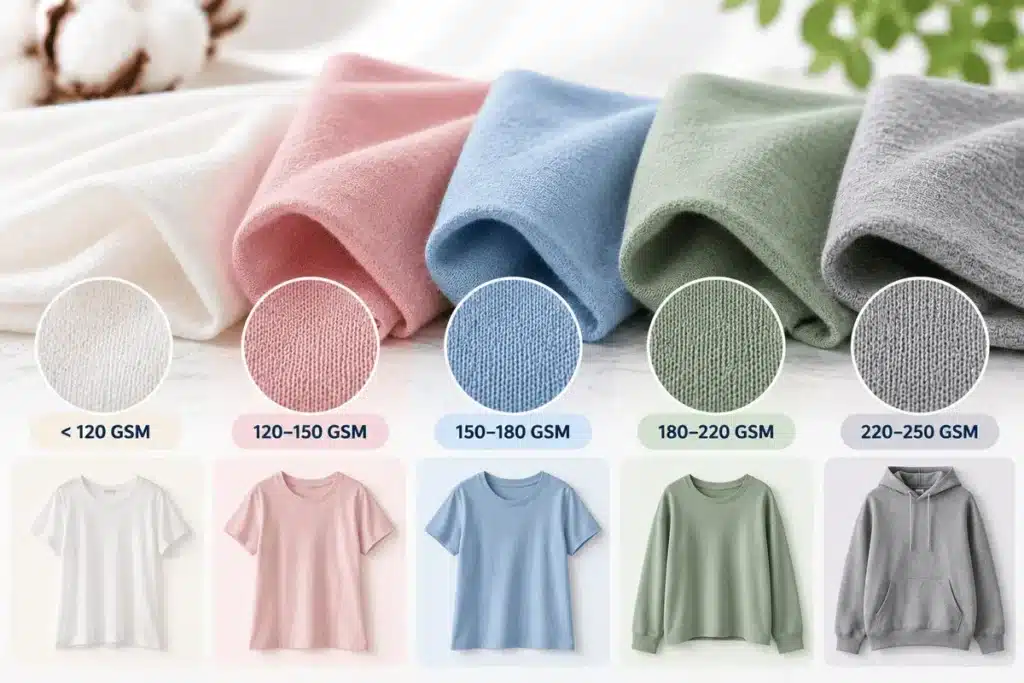
GSM stands for grams per square meter and measures fabric mass per unit area.
GSM is an important specification when selecting cotton jersey for T-shirts, dresses, sleepwear, or other garments.
Cotton jersey can be manufactured in a broad range of weights. Many apparel jerseys fall approximately between 120 and 250 GSM, but lighter and heavier products also exist.
Cotton Jersey GSM Comparison
| Fabric Weight | General Characteristics | Common Applications |
|---|---|---|
| Below 120 GSM | Very lightweight; may be more translucent | Lightweight layers, selected fashion tops |
| 120–150 GSM | Lightweight, flexible construction | Summer T-shirts, lightweight tops |
| 150–180 GSM | Common lightweight-to-medium apparel range | Everyday T-shirts, casual tops |
| 180–220 GSM | More substantial feel and coverage | Premium-feel T-shirts, casual dresses |
| 220–250 GSM | Heavier jersey with potentially more body | Structured casualwear, heavier tops |
| Above 250 GSM | Heavyweight construction | Selected oversized or specialty garments |
What Is the Best GSM for Cotton Jersey T-Shirts?
For many everyday T-shirts, approximately 150–200 GSM is a useful starting range.
Lighter jerseys may provide a softer, more flowing silhouette, while heavier jerseys may feel more substantial.
However, the ideal weight depends on the intended fit, season, design, and target market.
A premium T-shirt does not necessarily require the heaviest available fabric.
Is 180 GSM Cotton Jersey Good?
An 180 GSM cotton jersey is often a versatile option for casual tops and T-shirts.
It may offer a balance between lightness and coverage, depending on the construction.
Before selecting it for bulk production, check the actual fabric’s hand feel, shrinkage, opacity, and recovery.
Does Higher GSM Mean Better Quality?
No. Higher GSM means greater mass per square meter, not automatically better quality.
A lightweight cotton jersey made from well-controlled yarns and finished carefully may perform better for its intended use than a heavier but poorly constructed fabric.
Fabric quality should be evaluated using several criteria, including dimensional stability, pilling resistance, colorfastness, and consistent weight.
Is Cotton Jersey Material Stretchy?
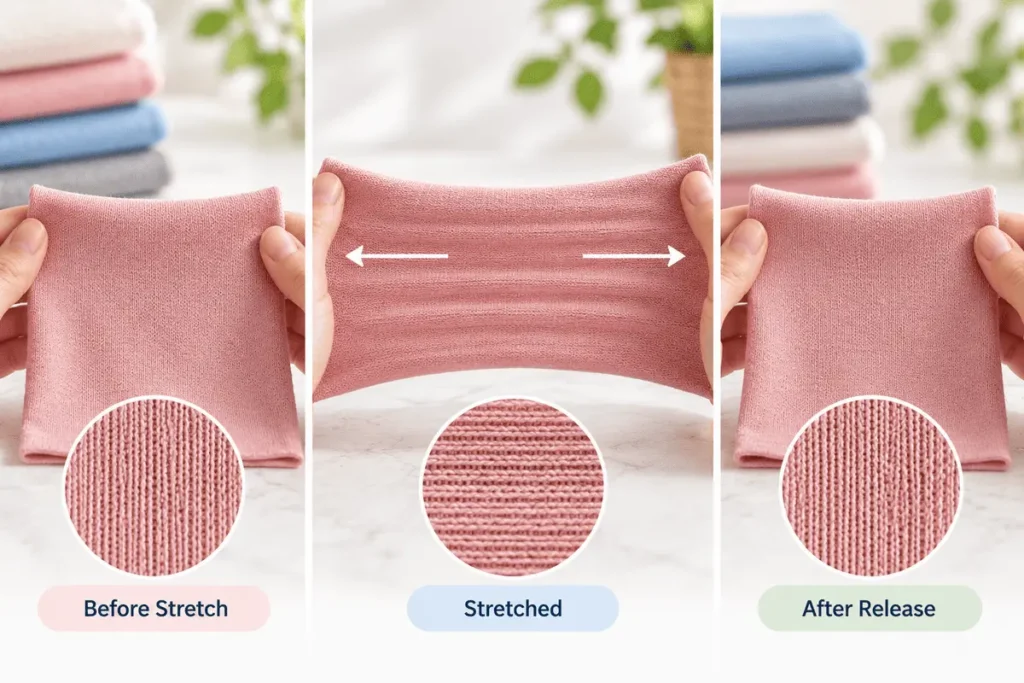
Yes. Cotton jersey material generally stretches because of its knitted loop construction.
However, the amount of stretch and its ability to recover depend on how the fabric is made.
Does 100% Cotton Jersey Stretch?
100% cotton jersey fabric can stretch even without spandex.
The knitted loops can extend when the fabric is pulled, particularly across the width.
However, cotton itself is not an elastomeric fiber. A 100% cotton jersey may not return to its original dimensions as effectively as a comparable jersey containing elastane.
Actual stretch and recovery vary with knit density, yarn properties, finishing, and test conditions.
Two-Way vs Four-Way Stretch
In garment sourcing, the terms two-way stretch and four-way stretch are commonly used, but suppliers may apply them inconsistently.
For accurate comparisons, request measured stretch percentages in both the lengthwise and crosswise directions.
A fabric that stretches mainly across its width may be suitable for a relaxed T-shirt.
A fabric requiring greater multidirectional stretch and recovery may need a different construction or a blend containing elastane.
Stretch Percentage vs Stretch Recovery
Stretch percentage describes how far a fabric extends relative to its initial length.
For example, if a 10 cm specimen extends to 14 cm under a specified test condition:
Stretch percentage = (14 − 10) ÷ 10 × 100 = 40%
Stretch recovery describes how effectively the material returns toward its original dimensions after the force is removed.
A fabric may have substantial stretch but relatively poor recovery.
For fitted garments, both properties matter.
100% Cotton Jersey vs Cotton Spandex Jersey
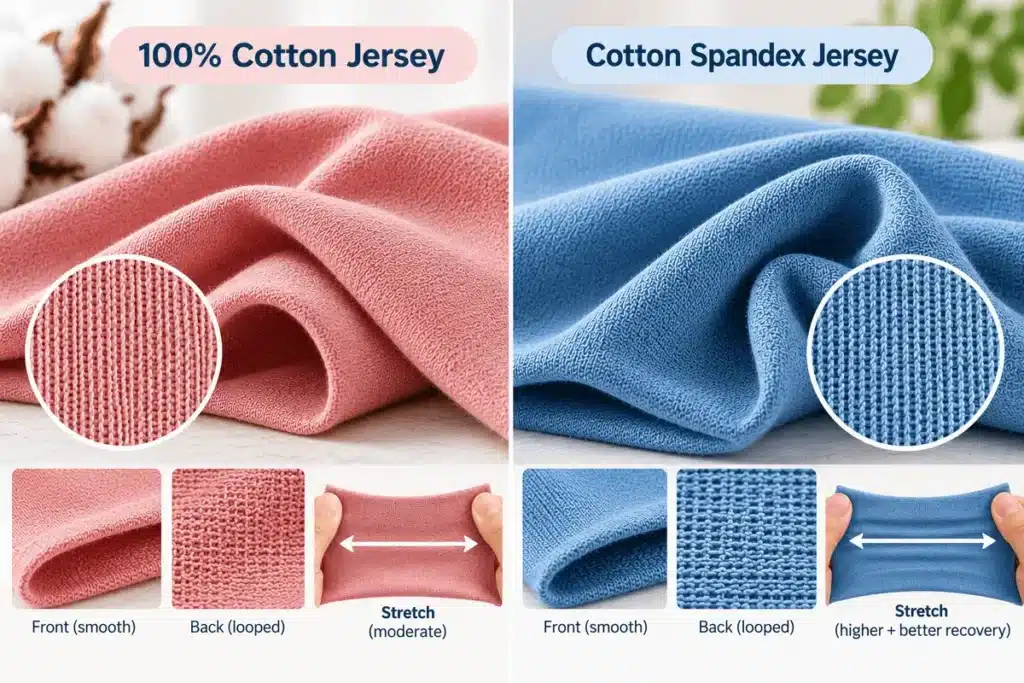
One of the most important buying decisions is whether to choose pure cotton jersey or a cotton-spandex blend.
Both can be comfortable knitted materials, but they are not interchangeable.| Feature | 100% Cotton Jersey | Cotton Spandex Jersey |
|---|---|---|
| Fiber composition | Cotton only | Cotton blended with elastane |
| Source of stretch | Knitted loop construction | Knitted construction plus elastane |
| Recovery | Varies; may be more limited | Often improved in comparable constructions |
| Hand feel | Depends on yarn and finishing | Depends on composition and construction |
| Common applications | T-shirts, relaxed tops, casualwear | Fitted tops, leggings, stretch garments |
| Fit considerations | Usually benefits from appropriate ease | Can support more body-hugging designs |
| Printing | Compatible processes depend on the fabric | Printing must account for stretch and recovery |
Which Fabric Should You Choose?
Choose 100% cotton jersey when the garment is intended to have a relaxed fit and the fabric’s natural knit flexibility is sufficient.
Consider cotton spandex jersey when the design requires greater stretch recovery, a close fit, or more demanding movement.
Always test the actual fabric before committing to production.
Types of Cotton Jersey Fabric
The term cotton jersey covers multiple knitted constructions and fabric specifications.
1. Single Cotton Jersey
Single jersey is one of the most common constructions used for casual apparel.
It is generally produced using a single set of needles and typically has different face and reverse appearances.
Common uses include T-shirts, casual tops, and lightweight dresses.
Some single jersey fabrics may curl at cut edges, which should be considered during cutting and sewing.
2. Cotton Spandex Single Jersey
This construction combines a jersey knit with elastane-containing yarns.
It is often selected for garments that require improved stretch and recovery compared with similar pure cotton constructions.
Applications may include fitted T-shirts, children’s clothing, and selected stretch dresses.
3. Cotton Interlock Knit
Interlock is a double-knit construction rather than ordinary single jersey.
It commonly has a smoother, more similar appearance on both sides and may offer greater body and dimensional stability than comparable lightweight single jersey.
Cotton interlock is frequently considered for baby clothing, comfortable tops, and selected casual garments.
4. Cotton Rib Knit
Rib knit uses alternating knit and purl stitch columns.
It typically offers substantial crosswise extensibility and is commonly used for neckbands, cuffs, fitted tops, and garment details.
Although rib knit is part of the broader family of weft-knitted fabrics, it should not be treated as identical to single jersey.
Cotton Knit Construction Comparison
| Construction | Main Characteristic | Common Uses |
|---|---|---|
| Single jersey | Smooth face, different reverse, flexible | T-shirts, tops |
| Cotton spandex jersey | Jersey construction with elastane | Fitted tops, stretch apparel |
| Interlock | Double-knit, more similar faces | Babywear, casualwear |
| Rib knit | Pronounced rib structure and crosswise stretch | Neckbands, cuffs, fitted garments |
Best Apparel Uses for Cotton Jersey Material
Cotton jersey is used across many categories of everyday clothing.
Cotton Jersey for T-Shirts
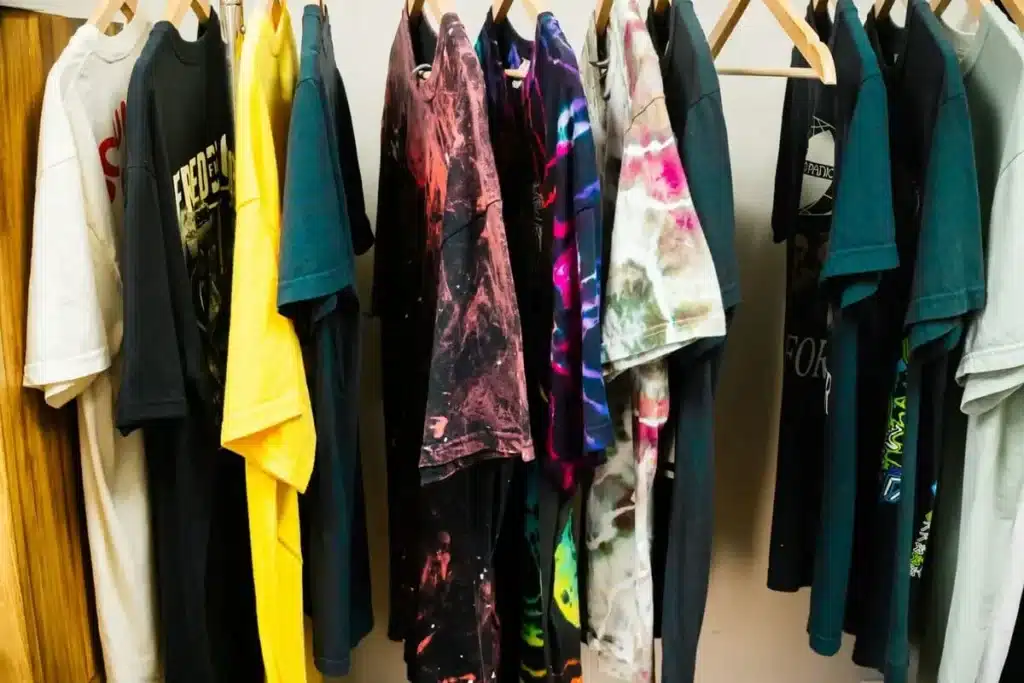
T-shirts are among the most common applications.
Cotton jersey offers a soft hand feel, comfortable movement, and flexible styling.
Fabric selection should account for garment fit, GSM, opacity, shrinkage, and print requirements.
For lightweight summer T-shirts, a lower GSM may be appropriate.
For oversized or more structured casual T-shirts, a heavier jersey may be preferred.
Cotton Jersey for Dresses
Cotton jersey can be used for relaxed dresses, T-shirt dresses, casual summer styles, and selected children’s garments.
Drape and fabric weight affect how the garment hangs.
For fitted dresses, the fabric’s stretch recovery becomes particularly important.
Cotton Jersey for Baby and Children's Clothing
Cotton jersey is commonly considered for soft, flexible children’s garments.
However, material suitability should be evaluated through appropriate testing and compliance with the safety requirements of the intended market.
Softness alone does not establish product safety.
Cotton Jersey for Loungewear
Jersey’s flexible construction makes it a practical option for relaxed loungewear.
Fabric weight and finishing can be adjusted to achieve different levels of softness, coverage, and warmth.
Cotton Jersey for Sleepwear
Cotton jersey may be used for certain sleepwear designs.
Manufacturers should evaluate dimensional stability, comfort, labeling, and applicable flammability or children’s sleepwear requirements in the destination market.
Cotton Jersey for Fashion Collections
For independent fashion brands, cotton jersey offers flexibility in garment silhouettes, fabric weights, and print designs.
It can be used for coordinated collections featuring T-shirts, dresses, casual tops, and related garments.
Cotton Jersey vs Cotton Lawn vs Cotton Poplin
Cotton jersey, lawn, and poplin can all be used in clothing, but their structures differ.
| Feature | Cotton Jersey | Cotton Lawn | Cotton Poplin |
|---|---|---|---|
| Construction | Knitted | Woven | Woven |
| Natural fabric stretch | Generally more flexible | Usually limited | Usually limited |
| Typical hand feel | Soft and flexible | Fine and lightweight | Often crisp and structured |
| Common uses | T-shirts, casual dresses | Blouses, summer dresses | Shirts, uniforms, dresses |
| Sewing considerations | Knit handling and stretch | Fine woven handling | Woven construction and seam control |
Can Cotton Jersey Material Be Digitally Printed?
Yes. Suitable cotton jersey materials can be printed using compatible digital textile printing processes.
However, printing results depend on the fiber composition, pretreatment, ink system, fixation, finishing, and knit construction.
Digital Printing on 100% Cotton Jersey
Cotton jersey may be printed using compatible reactive dye or pigment-based systems.
Reactive dye printing typically involves suitable pretreatment, fixation, washing, and finishing processes.
Pigment printing depends on the selected ink and binder system and its curing requirements.
Neither process is universally best for every cotton jersey application.
Printing on Cotton Spandex Jersey
Cotton spandex jersey requires additional attention to fabric extensibility and recovery.
Printed artwork should be evaluated for appearance after stretching, while finishing conditions must be compatible with the selected material.
What Designs Work Well on Cotton Jersey?
Common design directions include:
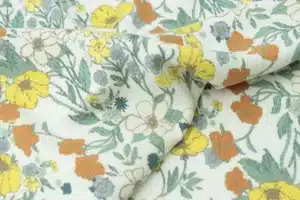
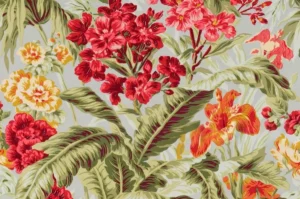
Floral and botanical repeats
Abstract prints
Geometric patterns
Children’s clothing motifs
Minimalist patterns
Custom brand artwork
The final print quality depends on the base fabric, printing method, artwork, and process control.
How to Prepare Artwork
Before printing, confirm the intended pattern scale, file resolution, color requirements, and repeat structure.
For repeat designs, check whether the artwork tiles seamlessly.
Review our Artwork Preparation Guide and Fabric Printing Methods Guide for more information.
Does Cotton Jersey Material Shrink?
Cotton jersey can shrink or change dimensions during washing and drying.
The amount depends on the yarn, knitting process, finishing, laundering conditions, and other factors.
It is not accurate to assign a single shrinkage percentage to all cotton jersey fabrics.
Why Can Cotton Jersey Shrink?
Dimensional changes may occur as tensions introduced during manufacturing are released during laundering.
Cotton fibers and knitted structures can respond to moisture, heat, and mechanical action.
How to Evaluate Shrinkage
For commercial garment production:
Request the supplier’s dimensional stability information.
Confirm the laundering and drying conditions used in testing.
Measure changes in both length and width.
Compare results with the garment’s required tolerances.
Test the finished printed fabric when relevant.
The appropriate acceptance limits depend on the garment specification and intended use.
Cotton Jersey Material Quality Testing
Before buying cotton jersey for a clothing collection, assess more than the advertised GSM.
Cotton Jersey Buying Checklist
| Quality Factor | What to Verify |
|---|---|
| Fiber composition | 100% cotton or confirmed blend |
| Knit construction | Single jersey, interlock, rib, or another knit |
| GSM | Finished fabric weight |
| Usable width | Actual cutting width |
| Stretch | Extension in relevant directions |
| Recovery | Return toward original dimensions |
| Shrinkage | Lengthwise and widthwise changes after laundering |
| Pilling | Resistance to surface fuzz and pills |
| Colorfastness | Relevant wash, rubbing, and other tests |
| Opacity | Coverage in the intended garment |
| Hand feel | Softness and surface finish |
| Printing suitability | Compatibility with selected printing process |
For standardized textile testing information, consult AATCC and ASTM International.
Why Fabric Samples Matter
Two cotton jerseys with the same GSM may differ in stretch, recovery, drape, softness, and shrinkage.
Sampling allows designers to evaluate the actual fabric rather than relying only on written specifications.
For commercial production, a printed sample and prototype garment may be especially valuable.
How to Choose Cotton Jersey Material by the Yard
Buying cotton jersey material by the yard allows designers and sewing enthusiasts to select quantities suited to their projects.
One linear yard equals 36 inches, or 91.44 cm, in length.
The amount of fabric received also depends on its usable width.
Before Ordering
Confirm:
Required fiber composition
Knit construction
GSM and usable width
Intended garment application
Stretch and recovery requirements
Print design and color requirements
Shrinkage expectations
Sample availability
Ordering increments and lead time
For a garment collection, calculate fabric consumption using the actual pattern pieces, cutting layout, and shrinkage allowance.
Cotton Jersey for Small Clothing Brands
Small brands may prefer to develop a collection using a limited number of base fabrics and several coordinated print designs.
This can simplify sampling, quality control, and production planning.
However, every fabric and print combination should be checked for suitability.
Custom Cotton Jersey Printing with JCWTextile
JCWTextile specializes in custom digital fabric printing for designers, sewing enthusiasts, small businesses, and wholesale customers.
Our custom printing services support projects without a minimum order requirement, making small-batch design development more accessible.
For cotton jersey projects, customers should confirm the availability and specifications of the required base fabric before placing an order.
Important specifications include fiber composition, GSM, usable width, printing compatibility, and finishing requirements.
Explore our Fabric Collection to review material options.
Conclusion
Cotton jersey material is a versatile knitted textile used in T-shirts, casual dresses, loungewear, and many other apparel products.
Understanding cotton jersey GSM, stretch, recovery, knit construction, and shrinkage helps buyers select the right fabric for each application.
A lightweight jersey may suit a flowing summer top, while a heavier construction may provide more body for casualwear. Cotton spandex blends may be preferable when a garment requires greater stretch recovery.
For clothing brands and designers, the best approach is to compare real fabric samples and verify printing compatibility before production.
Planning a custom printed cotton jersey project?
Explore Our Fabrics, visit Design Your Fabric, or Contact JCWTextile for a Quote.
📚 FAQ About Cotton Jersey Material
1. What is cotton jersey material?
Cotton jersey material is a knitted textile made entirely or primarily from cotton fibers. It is commonly used for T-shirts, dresses, casualwear, and other comfortable garments.
2. Is cotton jersey fabric 100% cotton?
Some cotton jersey fabrics are 100% cotton, while others contain spandex, polyester, or additional fibers. Always check the product composition.
3. Is cotton jersey material stretchy?
Yes. Its knitted construction allows it to stretch, although the amount of stretch and recovery depends on the fabric.
4. What GSM is best for cotton jersey T-shirts?
Approximately 150–200 GSM is a useful starting range for many everyday T-shirts, but the ideal weight depends on the garment design and desired feel.
5. Is 180 GSM cotton jersey good quality?
An 180 GSM jersey can be suitable for everyday apparel, but GSM alone does not determine quality. Construction, shrinkage, recovery, and finishing also matter.
6. What is the difference between cotton jersey and cotton spandex?
Cotton jersey describes a knitted fabric that may be 100% cotton. Cotton spandex describes a fiber blend containing cotton and elastane, which can also be knitted into jersey.
7. Does 100% cotton jersey stretch without spandex?
Yes. Knitted loops provide mechanical stretch, although recovery may be more limited than in comparable fabrics containing elastane.
8. Does cotton jersey shrink after washing?
It can. Shrinkage depends on construction, finishing, and laundering conditions. Request actual dimensional stability data where possible.
9. Can cotton jersey be digitally printed?
Yes. Suitable cotton jersey fabrics can be digitally printed using compatible processes. Printing and finished fabric performance should be checked through sampling.
10. Is cotton jersey suitable for summer clothing?
Yes. Lightweight cotton jersey is commonly used for summer T-shirts, casual tops, and dresses. Comfort depends on fabric weight, construction, and garment design.